An Anchoress’ life was hard! They were women who chose an austere, solitary, religious life, confined to a single cell (an anchorhold) – usually with a just single room, and never more than three, which was frequently attached to the wall of a church. Often they were actually bricked in. In some ways they were like hermits, but, instead of dwelling in a cave or forest, the Anchoress lived in the community and was treated as a wise woman and advisor.
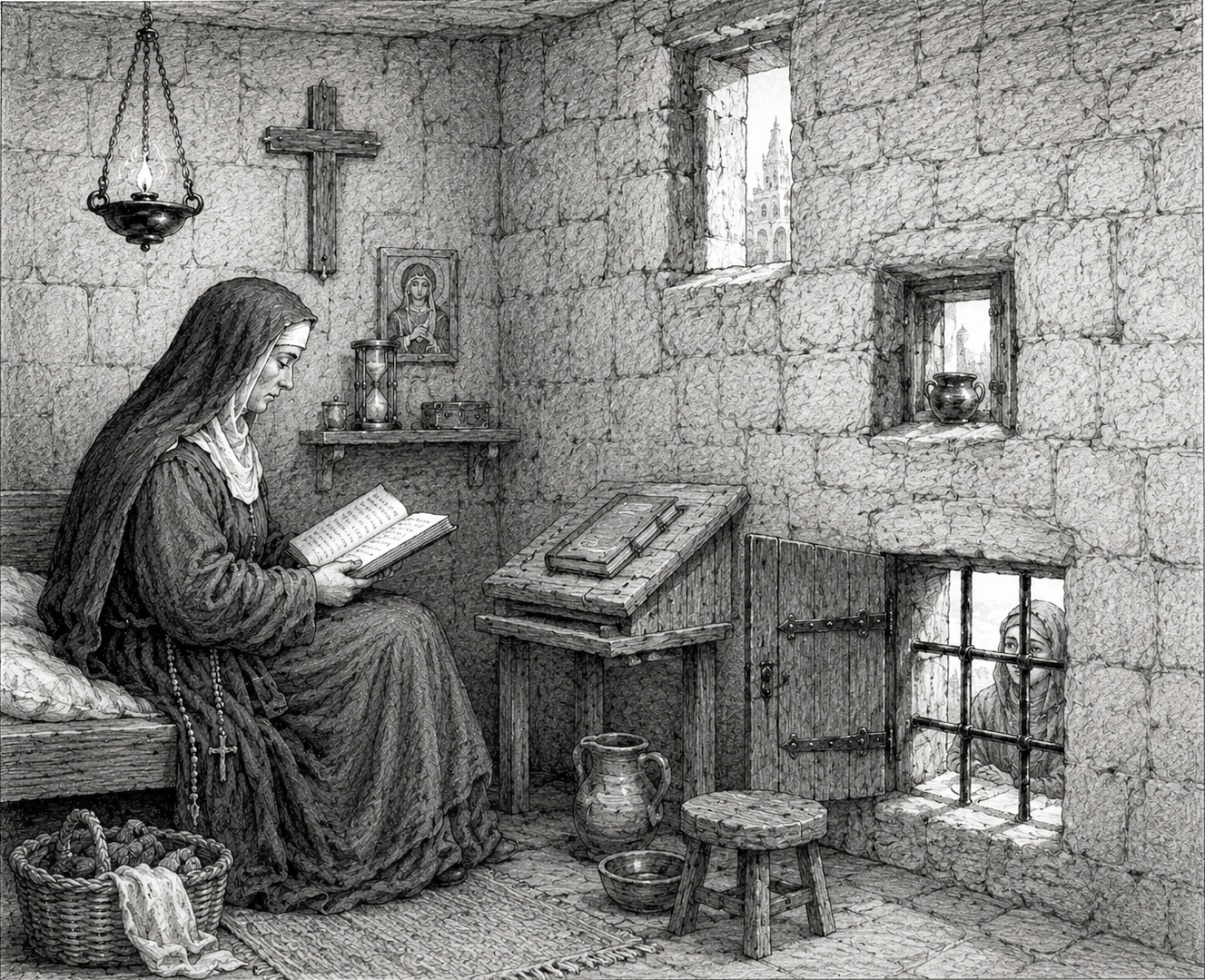
An anchoress’ life was hard! Anchoresses were women who chose an austere, solitary religious life, confined to a single cell known as an anchorhold. This usually consisted of just one room, occasionally two or three, and was frequently built against the wall of a church. The entrance might be sealed after the anchoress entered.
In some ways they were like hermits but, instead of retreating to a cave, forest or desert, the anchoress remained physically at the heart of her community. This produced one of the great paradoxes of the anchoress’ life: by withdrawing from the world she could find herself squarely at the centre of it. Local people came to her for prayers, spiritual guidance and advice.
The male equivalent was an anchorite, although men appear to have been considerably less common. There were many hermits around the Marlow area over the centuries – one is said to have lived at Elizabeth’s Well in Bisham – but the nearest proven anchorites include examples from eight London parishes, Oxford and St Albans, with hints of them at both Henley and Colnbrook.
The Anchoresses’ Guide
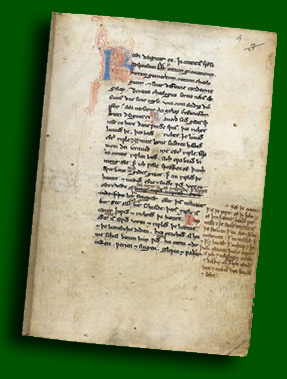
Anchoresses followed religious rules, the best-known English example being the Ancrene Wisse, usually translated as the Anchoresses’ Guide. It was produced sometime between about 1225 and 1240 and developed from an earlier version, the Ancrene Riwle. The work appears originally to have been intended for three well-born sisters who had chosen enclosure somewhere in the West Midlands, probably in the region between Worcester and the Welsh border.
Unusually for the period, Ancrene Wisse was written in English rather than Latin. Exactly why is uncertain. It may reflect the education of the women for whom it was written, who may have been able to read French but not Latin.
An anchoress was not simply a nun in solitary confinement. She occupied a distinctive religious position and might previously have been a laywoman, widow or nun. Becoming an anchoress was a separate vocation requiring the approval of the Church.
The tradition itself was much older. The earliest Christian anchorites were ascetic hermits who retreated into the Egyptian desert during the early centuries AD, seeking God through isolation, prayer and self-denial. Abba Paul, traditionally regarded as one of the first, was reputedly supplied with half a loaf of bread each day by a crow, while St Onuphrius supposedly survived partly on dates from a palm tree.
Becoming Dead to the World
Becoming an anchoress was not easy. Permission was required from the bishop, who had to satisfy himself that the candidate was spiritually and psychologically suited to such an extreme life. Sometimes a probationary period was required.
There was also the distinctly practical matter of money. The bishop needed to be confident that sufficient funds existed to maintain the woman for the rest of her life, including the cost of servants. An anchoress could potentially remain enclosed for decades and somebody had to feed, clothe and support her. Gifts and bequests could contribute to her upkeep.
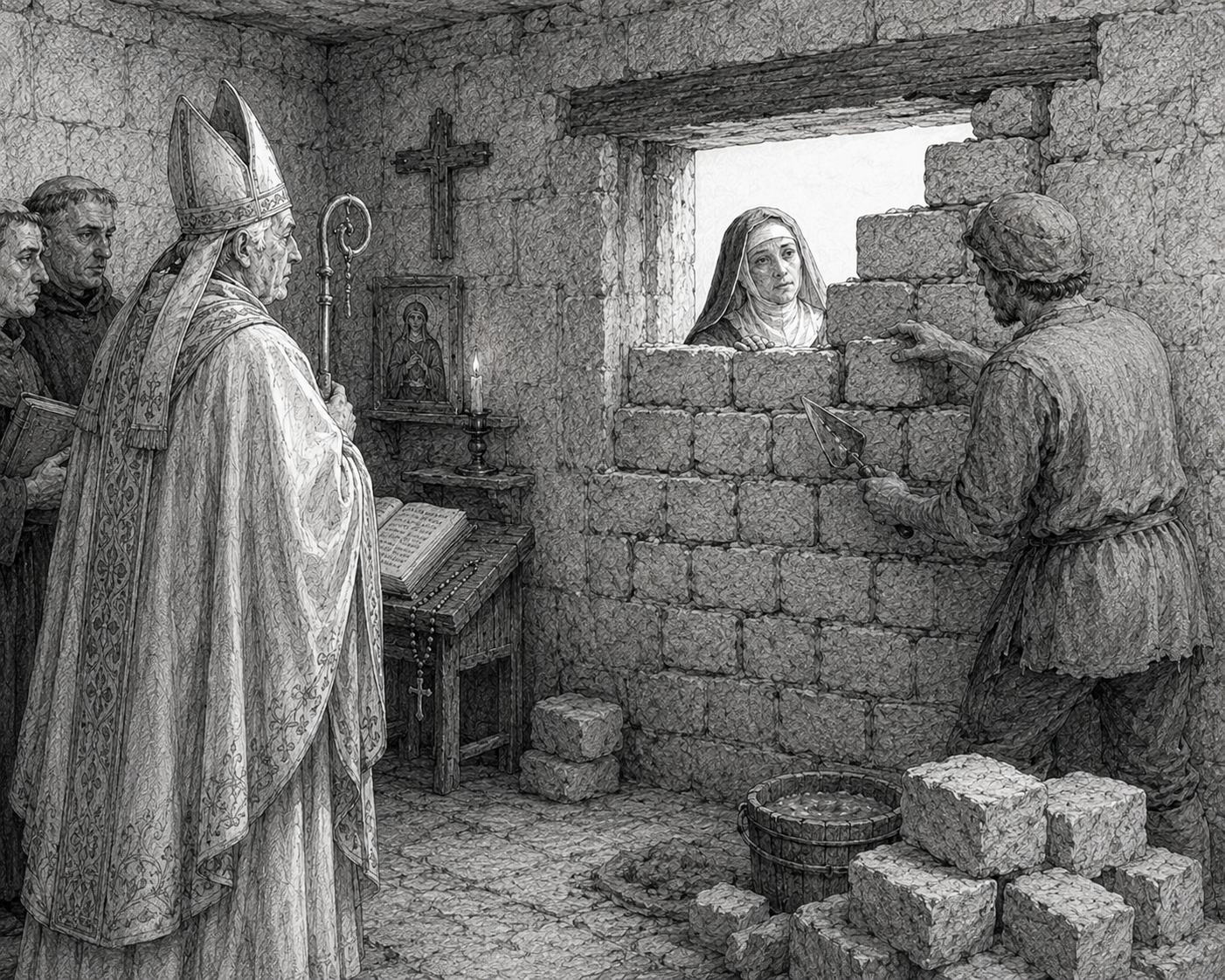
Once these hurdles had been overcome, the bishop performed the solemn rite of Enclosure. Some versions deliberately resembled a funeral. The prospective anchoress might lie on a funeral bier and receive rites symbolising her death to the secular world. She then entered her anchorhold and the entrance could be closed or sealed.
She was, symbolically at least, dead to the world – although, as we shall see, the world showed remarkably little inclination to leave her alone.
Life Inside the Cell
Ancrene Wisse envisaged three small openings in the ideal anchorhold.
The most important was a small hagioscope, or squint, looking into the church sanctuary. Through it the anchoress could hear and sometimes see services and receive Holy Communion.
Another opening communicated with her servant or household. Food could be passed in and refuse and other items passed out.
The third connected her with the outside world. Through it visitors could seek her prayers, wisdom and advice.
The windows were supposed to be small and carefully controlled. The purpose was not to provide an agreeable view but to permit only those contacts necessary for religious and practical life.
Anchoresses were intended to remain in their cells for the rest of their lives. The commitment could be taken extraordinarily seriously. Medieval accounts even describe anchorites refusing to abandon their cells when their communities were attacked and burned.
What Did an Anchoress Wear?
Although anchoresses generally wore coarse and simple garments, the overriding rule was that clothing should be plain rather than fashionable.
Winter clothing could include a warm garment known as a pilch, while other clothing included a kirtle and mantle, together with a black head-dress, wimple, cape or veil.
The rules also descended to wonderfully mundane matters. Anchoresses were allowed to wash themselves and their possessions, their hair could be cut several times a year and winter footwear was supposed to be large, soft and warm.
Even the most dedicated medieval mystic apparently suffered from cold feet.
She Could Even Keep a Cat
There was also one particularly appealing concession.
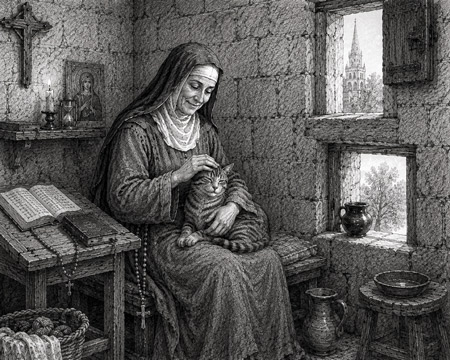
Ancrene Wisse discouraged anchoresses from keeping animals because caring for them might distract from their religious vocation. But there was an exception:
an anchoress could keep one cat.
Apart from companionship, this was eminently practical. A tiny medieval room containing food, cloth and valuable manuscripts would have provided an attractive home for mice. A resident cat therefore combined spiritual acceptability with highly effective medieval pest control.
A Very Long Day
Daily life was hard, monotonous and highly prescribed. The precise timetable could vary but a typical routine reconstructed from the religious observances expected of an anchoress might look something like this:
3–5 a.m. Preliminary devotions and prayers followed by Matins, Lauds, Suffrages, Commendations and a Litany of the Saints.
5–6 a.m. Hearing the priest’s celebration of the canonical hours.
6–7 a.m. Prime.
7–8 a.m. Preciosa.
8–9 a.m. Terce.
9–10 a.m. Prayers and supplications and devotions before the Cross.
10–11 a.m. Devotions to Our Lady, the Penitential Psalms and other prayers.
11 a.m.–12 noon. Mass.
12–1 p.m. Sext and None.
2–3 p.m. Rest period.
3–5 p.m. Private prayer, reading the Psalter and other religious works and plain needlework, perhaps making church vestments or clothing for the poor, followed by Vespers and a meal.
5–7 p.m. Compline, bedtime prayers and devotions.
Matins, Lauds, Prime, Terce, Sext, None, Vespers and Compline were the traditional services or periods of prayer that structured the religious day.
There was, in other words, relatively little time for putting one’s feet up – even if they were comfortably accommodated in those large winter shoes.
How Many Were There?
Surviving records suggest that the anchoress was by no means an extraordinary rarity in medieval England.
| Century | Female | Male | Indeterminate | Total |
| 12th | 48 | 30 | 18 | 96 |
| 13th | 123 | 37 | 38 | 198 |
| 14th | 96 | 41 | 77 | 214 |
| 15th | 110 | 66 | 28 | 204 |
| First half of 16th | 37 | 27 | 4 | 68 |
The figures are particularly interesting because women considerably outnumber men during much of the period.
But Why Would Anyone Do It?
To modern eyes it seems extraordinary that women voluntarily chose such a restricted existence. Why exchange ordinary life for permanent confinement in a small stone room?
Part of the answer was obviously religious. To the medieval Christian, withdrawing from worldly distractions in order to devote an entire life to God could represent an exceptionally powerful vocation.
Yet there was another side to it.
Although physically confined, a respected anchoress could acquire considerable standing in her community. People sought her prayers and spiritual advice and prominent anchoresses could become well-known far beyond their immediate neighbourhood.
Officially, however, the anchorhold was most definitely not supposed to become the medieval equivalent of a bank, post office, school, shop or news agency. Ancrene Wisse warned against commercial dealings, running a school, inappropriate correspondence, gossip and looking after other people’s possessions.
The fact that the author felt it necessary to issue such instructions rather suggests that some anchoresses were doing precisely these things.
The anchoress therefore occupied an extraordinary position. She had renounced society while remaining physically within it. She could neither go to the marketplace nor visit her neighbours, but her neighbours could come to her.
Some became celebrated spiritual advisers. Two particularly famous English examples were Christina of Markyate and, above all, Julian of Norwich.
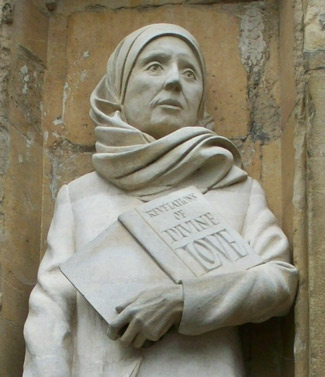
Julian of Norwich
Julian of Norwich was probably born in about 1342. Even her name presents us with a mystery. We do not know whether Julian was her birth name; she may instead have acquired it from St Julian’s Church in Norwich, against which her anchorhold stood.
When she was about thirty she became seriously ill and appeared to be close to death. After receiving the last rites she experienced a series of extraordinary mystical visions. She recovered and subsequently reflected and wrote about these experiences, which she called her Revelations or Showings.
They eventually became Revelations of Divine Love, generally regarded as the earliest surviving book written in English known to have been written by a woman.
Julian lived to a considerable age and survived through an extraordinary period of English history encompassing outbreaks of the Black Death, the Hundred Years’ War, the Peasants’ Revolt and the Great Western Schism.
Nor was she completely alone in her cell. Documentary evidence suggests that Julian had servants, including women named Sarah and Alice, and at least part of the anchorhold seems to have provided accommodation associated with her attendants.
She also became sufficiently famous for people to seek her spiritual counsel. The mystic Margery Kempe, for example, recorded visiting Julian and discussing her religious experiences with her.
During the Reformation the medieval religious world that had produced the anchoresses largely disappeared. Julian’s anchorhold did not survive intact and St Julian’s Church itself was badly damaged by bombing during the Second World War. Post-war investigations revealed foundations believed to be associated with the medieval anchorhold and a cell was reconstructed as part of the restored church.
It is perhaps a fitting survival.
The anchoress had chosen to disappear from the world, yet the world continued to come to her window. More than six centuries later, people still travel to Norwich to visit the place associated with Julian – a woman who spent decades confined to a few square yards, yet wrote a book whose words travelled far beyond the walls that enclosed her.