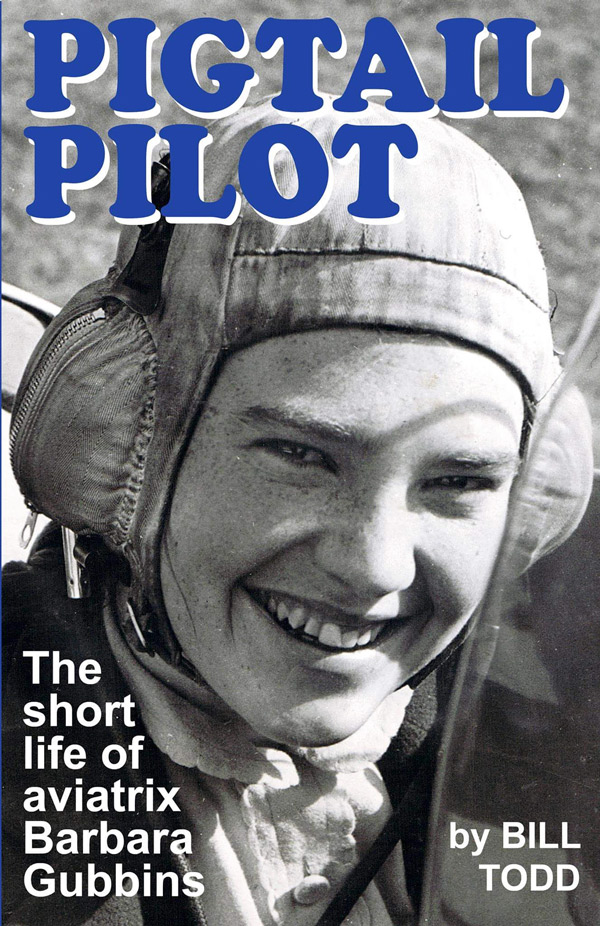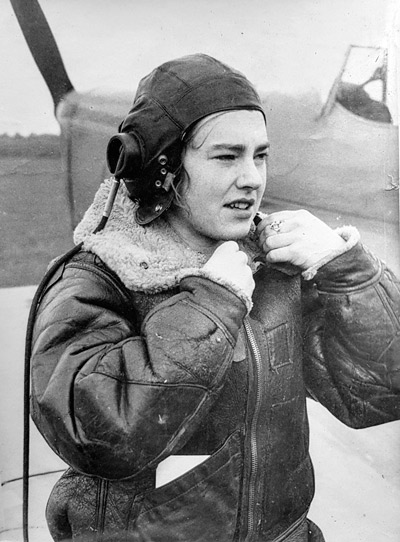
Barbara Gubbins – the young aviator the newspapers dubbed “The Pigtailed Pilot” – was one of the brightest prospects among Britain’s post-war female flyers. By the age of just twenty she had already logged more than 150 hours in the air and was regarded as an exceptionally talented pilot. Had she lived, it was believed that she could have become the first woman to receive RAF pilot wings. Perhaps, given time, she might even have joined the celebrated ranks of female aviation pioneers such as Amelia Earhart and Amy Johnson.
But Barbara never had that time.
On 5 March 1952, while undertaking an advanced training exercise, her aircraft crashed in Derbyshire, killing Barbara and her instructor. She was just twenty years old.
What makes her story particularly poignant for us locally is that this remarkable young woman was born in High Wycombe, on West Wycombe Road, on 9 April 1931. And although aviation would make her briefly famous, there was much more to Barbara Gubbins than the girl with pigtails who flew aeroplanes.
She was an outstanding sportswoman, a county hockey player, horsewoman and riding instructor, a talented scientist and even a prize-winning bicycle designer. She studied chemistry, pure mathematics and physics at university and possessed an infectious enthusiasm which friends and school contemporaries clearly remembered long after her death.
This is her story.
A Young Woman in Love with Flying
Barbara Mary Gubbins grew up in an era when aviation still carried an air of glamour, danger and excitement. The 1930s and 1940s were decades in which flight captured the public imagination, with pilots regarded as daring adventurers and national heroes. Britain had already celebrated the achievements of famous aviators such as Amy Johnson, but opportunities for women in aviation remained limited, especially in military settings. Against this backdrop, Barbara developed a fascination with flying from a young age. Unlike many childhood dreams that fade with time, her passion only intensified and by her early teens she had already become determined to pursue aviation seriously.
Even when young, Barbara was known for her intelligence, discipline and seemingly inexhaustible energy. She attended Green Street School followed by Wycombe High School, where she distinguished herself as an excellent student, particularly in mathematics and the sciences. These subjects would later complement her aviation ambitions, as piloting demanded not only courage but technical knowledge and precision.
Fortunately, memories preserved by her school reveal something of the person behind that impressive list of accomplishments. During her final year Barbara arrived in the laboratory determined to try an experiment she had read about. When it succeeded, she delightedly held up the test tube and announced: “Look, it really works!” It is a wonderfully ordinary little moment that captures her curiosity and enthusiasm for discovering how things worked.
That curiosity also had a practical side. While in the Fifth Form Barbara even won a prize for an imaginative design for a bicycle – perhaps an early indication of the combination of scientific and mechanical interests that would later serve her so well in aviation.
She was also an accomplished horse rider and took part in rifle shooting, displaying the same competitive spirit and fearlessness that would later characterise her flying career.
Beyond academics, Barbara was exceptionally athletic. She captained both the hockey and tennis teams, played county hockey and became school games captain in 1949–50. She also took part enthusiastically in gymnastics. One school recollection tells how Barbara became so enthusiastic about a gymnastics competition that she managed to persuade even some of the “most unlikely” Upper Sixth girls to practise for it. It suggests that she possessed not merely determination herself, but the rather valuable ability to infect other people with her enthusiasm.
Barbara’s determination to become a pilot was so strong that she found practical ways to fund her own flying lessons. At a time when flight training was expensive and not easily accessible, especially for young women, she earned money through fruit-picking and by giving horse-riding lessons. This demonstrated not only dedication but a remarkable level of maturity for someone still in her teens. She was not content simply to dream of becoming a pilot; she worked to make it happen.
A Natural Pilot
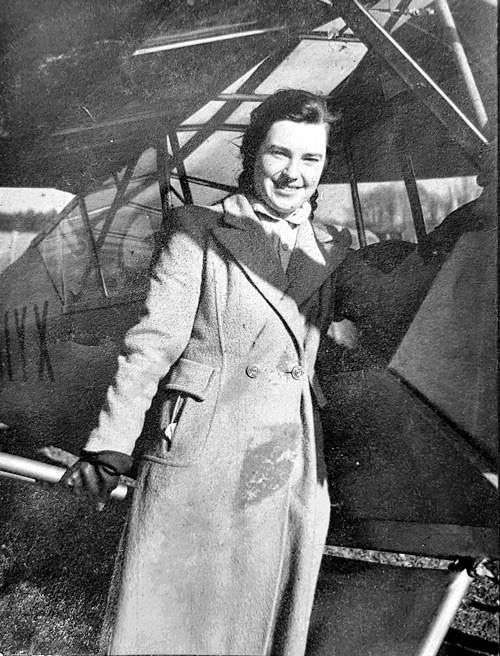
She learned to fly at Denham Airfield and Booker Airfield and was a member of both Denham Aero Club and High Wycombe Flying Club. Her natural aptitude for flying quickly became apparent. Barbara achieved her first solo flight at the age of seventeen after only around five and a half hours of instruction, a notably short training period that reflected her exceptional ability.
Flying solo is one of the most important milestones in any aviator’s training and to achieve it so quickly indicated not only technical skill but calmness under pressure and a strong instinctive understanding of aircraft handling.
As Barbara’s flying experience increased, so too did her reputation. Her youthful appearance and long hair, often styled in pigtails, led newspapers to dub her “The Pigtailed Pilot”, a label that captured the public imagination and made her something of a media curiosity. While the nickname reflected the era’s tendency to focus on the novelty of a young woman flying aircraft, it also helped make Barbara more widely known. She presented a striking image of youth, femininity and daring in a field dominated almost entirely by men.
At the same time as developing her flying career, Barbara continued her academic studies. She went to Nottingham University, where she studied chemistry, pure mathematics and physics. It was an academically demanding combination and demonstrates that Barbara was much more than a naturally talented pilot. Balancing university education with aviation training was no small feat, yet she managed both successfully.
Barbara eventually joined the Women’s Royal Air Force Volunteer Reserve (WRAFVR), a path that placed her on track for what many believed could have been a groundbreaking future. In the early 1950s the British armed forces were still only beginning to explore greater roles for women and female pilots were not yet part of the Royal Air Force in the way they would later become.
Barbara’s performance and promise led many to believe that she would have become the first woman to receive RAF pilot wings had she lived. This possibility makes her story especially significant in the history of women in British aviation, as she stood at the forefront of changing attitudes towards women’s capabilities in military and technical roles.
By the age of twenty, Barbara had logged more than 150 flying hours. She had flown a variety of aircraft and was regarded as one of the brightest young flying prospects in Britain. Her instructors and peers reportedly admired both her technical ability and her confidence in the cockpit.
Her achievements were particularly impressive because she reached this level in an age before modern aviation technology and safety systems. Aircraft of the period were far less forgiving than those used in contemporary flight training and mastering them required a high degree of concentration and skill.
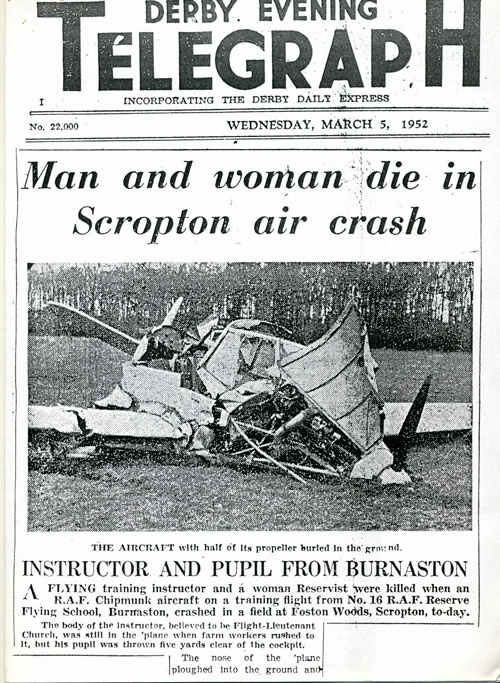
Tragedy
However, the same era that romanticised flying also carried great danger. Aviation in the early post-war period was inherently risky, with accidents far more common than they are today. Military and training aircraft lacked many of the safety systems, navigation tools and engineering improvements that modern pilots rely upon. Even the most talented aviators operated in an environment where mechanical failure, weather or relatively minor misjudgements could quickly prove fatal.
On 5 March 1952, tragedy struck.
Barbara was participating in a training exercise in a Percival Prentice aircraft near Scropton, Derbyshire. Accompanied by her instructor, Flight Lieutenant Eric Church, she was undertaking spin-recovery manoeuvres – an advanced and demanding aspect of pilot training designed to teach aviators how to recover from dangerous spinning descents.
At some point during the exercise, the aircraft entered a spin from which it could not recover. It crashed, killing both Barbara and her instructor instantly.
Barbara Gubbins was just twenty years old.
Her death shocked those who knew her and saddened many in the wider aviation community. Newspapers that had once celebrated the “Pigtailed Pilot” now reported the tragic loss of a young woman whose life had promised so much. For High Wycombe, the town of her birth, it marked the loss of one of its most remarkable young talents. For British aviation, it represented the end of a career that many believed could have changed the role of women in military flying.
More than a Pigtailed Pilot
Though Barbara’s life was brief, her story has endured partly because of what she represented. She belonged to a generation of young women who emerged after the Second World War increasingly determined to enter professions and pursuits previously dominated by men. The war had demonstrated that women could contribute enormously in technical, military and industrial roles and Barbara stood among those pushing that progress further.
Yet there is a danger in making Barbara merely a symbol of female progress or remembering her only as the young pilot whose promising career ended tragically. The smaller details of her life reveal someone rather more interesting.
She was a scientist who was delighted when an experiment worked; a sportswoman who could persuade reluctant schoolfriends into gymnastics practice; a county hockey player and tennis captain; a horsewoman and riding instructor; a rifle shooter and a prize-winning bicycle designer. She seems to have possessed an unusual combination of intelligence, competitiveness, curiosity, enthusiasm and sheer determination – and, importantly, an ability to persuade others to share that enthusiasm.
Her legacy has been preserved in part through local remembrance. Wycombe High School has maintained links to her memory through prizes and commemorations, ensuring that future generations of students learn about one of the school’s most distinguished former pupils. Aviation historians also continue to mention her as an important “what if?” figure – a pilot whose short life inevitably invites speculation about what she might have achieved had she survived.
Barbara Gubbins remains compelling not only because of her accomplishments but because of the sense of unrealised potential surrounding her story. Many historical figures are remembered for what they completed; Barbara is remembered equally for what she might have become. She had already achieved more by twenty than many people achieve in a lifetime, yet all the evidence suggests that her greatest achievements still lay ahead.
Barbara deserves recognition not merely as a tragic footnote in aviation history but as a pioneering figure in her own right. Born in High Wycombe, she rose from local beginnings to national attention through talent, perseverance and courage. She challenged expectations and excelled in one of the most demanding fields imaginable.
But perhaps the most attractive way to remember her is not simply as the daring “Pigtailed Pilot” sitting at the controls of an aircraft. We can also picture the energetic schoolgirl playing hockey, studying at university, designing a bicycle, riding horses, persuading her friends to practise gymnastics – or standing excitedly in a school laboratory, holding up a test tube and exclaiming: “Look, it really works!”
From her birth in High Wycombe to the burial of her ashes at St Nicholas Church in Hedsor, where her mother was headmistress of the school and her father was a police sergeant, Barbara lived with purpose, bravery and extraordinary enthusiasm. Her story remains one of the most inspiring and poignant examples of local Buckinghamshire history – a reminder not merely of what might have been, but of just how much one young woman managed to fit into twenty short years.