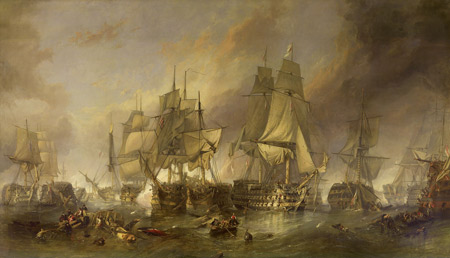
When Admiral Nelson sailed into history at the Battle of Trafalgar in October 1805, the Royal Navy’s greatest advantage was not simply better seamanship, superior gunnery or inspired leadership. Hidden beneath the waterline of every British warship was another secret weapon – copper.
It is easy to overlook today, but copper sheathing transformed naval warfare. It allowed British warships to remain at sea for months longer than their rivals, sail faster, manoeuvre more easily and spend far less time in dock for repairs. In many ways, Britain’s command of the sea rested upon thousands of sheets of rolled copper nailed to the hulls of its ships.
Remarkably, this story has an unexpected connection with Marlow.
By the middle of the eighteenth century, wooden ships faced two constant enemies beneath the waves. In warm waters, shipworm attacked the timbers with astonishing speed, while everywhere the hull became coated with barnacles, weed and shellfish. Within a few months a fast warship could become slow, sluggish and difficult to handle.
The solution was discovered in the 1760s. The Royal Navy began covering the underwater hulls of its ships with thin sheets of copper. The metal proved toxic to marine growth, while also protecting the timber from shipworm. It was one of the most successful technological innovations in naval history.
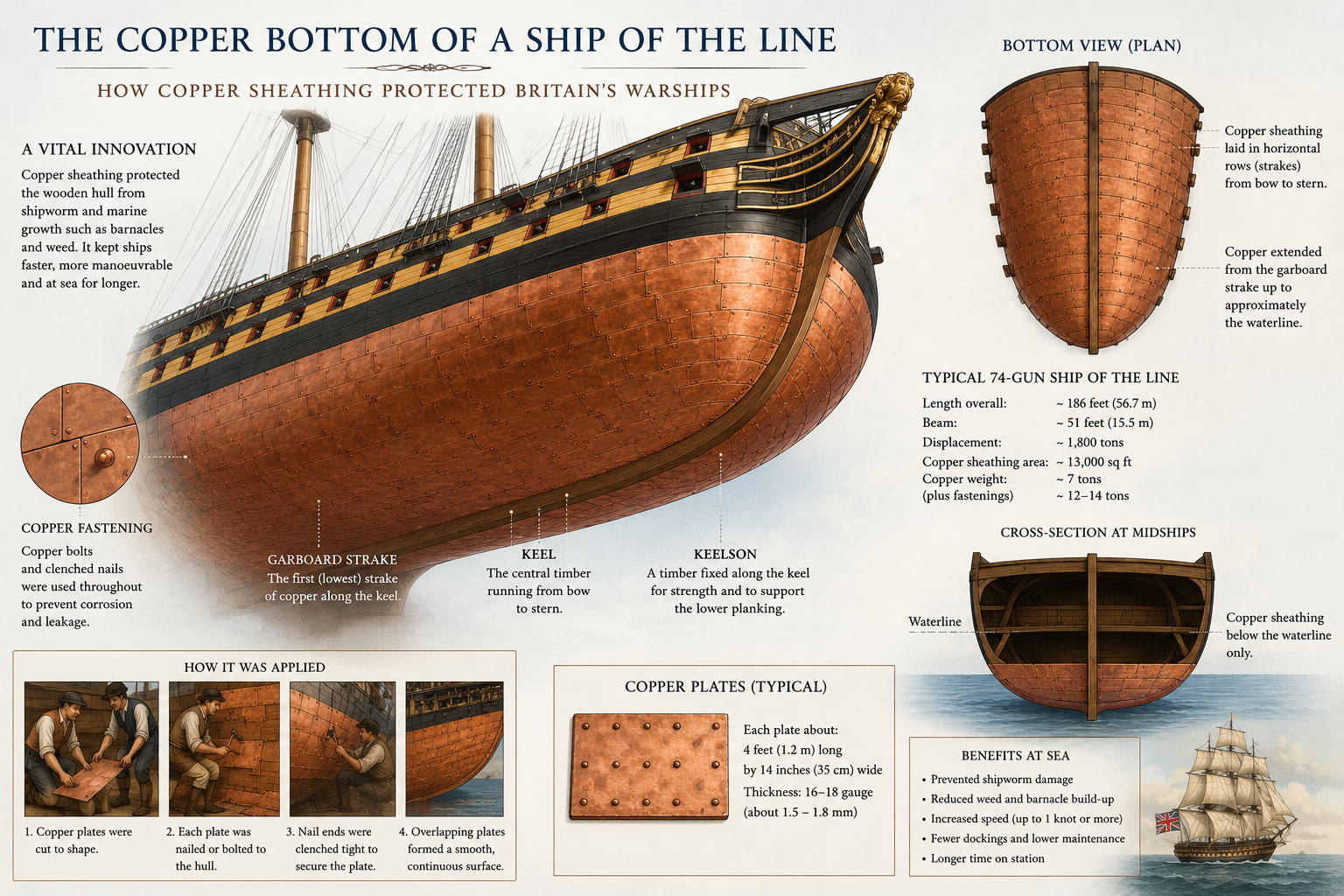
A typical 74-gun ship of the line, the workhorse of Nelson’s fleet, required somewhere in the region of 3,000 copper plates, each measuring about four feet by fourteen inches. Altogether they covered over 13,000 square feet of hull – an area approaching three tennis courts. The copper itself weighed around seven tons, while the complete installation, including copper bolts and fastenings, could exceed a dozen tons.
Supplying such quantities demanded an enormous industrial effort. The answer lay hundreds of miles away on Anglesey.
There, at Parys Mountain, one of the richest copper deposits ever discovered was producing astonishing quantities of ore. At its height the mine supplied around half of Britain’s copper and perhaps half of the world’s production. The man who turned this mineral wealth into an industrial empire was Thomas Williams (1737-1802), remembered by contemporaries as “The Copper King”.
Williams had begun life not as an engineer or miner but as a country lawyer. After becoming involved in a long-running legal dispute over the ownership of the Parys Mountain mines, he gradually emerged as the driving force behind their management. Possessing a formidable business brain, he realised that the greatest profits would come not simply from mining copper but from controlling every stage of production.
He established what today we would call a vertically integrated business. His companies mined the ore, transported it in their own ships, smelted, rolled it into sheets, manufactured copper products and sold them directly to his customers. During the 1780s he brought together the Parys and Mona mines, established smelting works close to the coalfields of South Wales and Lancashire, acquired rolling mills and manufacturing works, developed his own shipping fleet and secured contracts with the Admiralty. Few businessmen of the eighteenth century thought on such a scale.
The Royal Navy became one of his most important customers. By the time of Trafalgar virtually every British ship of the line had been coppered, and Williams’ businesses were among the principal suppliers of the sheathing plates, copper bolts and fastenings. It has even been suggested that he helped popularise the use of copper bolts instead of iron, reducing corrosion and making ships even more durable.
So where does Marlow fit into the story?
In 1788 Thomas Williams purchased Temple Mills at Bisham, just across the Thames from Marlow. Originally established as brass battery mills powered by water, Williams converted them into an important part of his copper manufacturing business. Soon afterwards he built Temple House nearby and, in 1790, was elected Member of Parliament for Great Marlow.
Temple Mills became one of the largest industrial employers in the district and was probably the biggest employer of labour in Great Marlow during this period. While no complete list of employees survives, many of the men and women working there almost certainly came from Marlow, Bisham, Cookham, Hurley and neighbouring villages. Some would have operated the water-powered rolling mills that produced copper sheet, while others worked as labourers, warehousemen, carters and boatmen transporting materials along the Thames.
His timing could hardly have been better. The Royal Navy’s decision to copper the hulls of its ships created an almost insatiable demand for rolled copper sheets, bolts and fastenings. Williams’ businesses became one of the Admiralty’s principal suppliers. Every ship that emerged from the dockyards with a gleaming copper bottom represented another customer for his growing industrial empire.
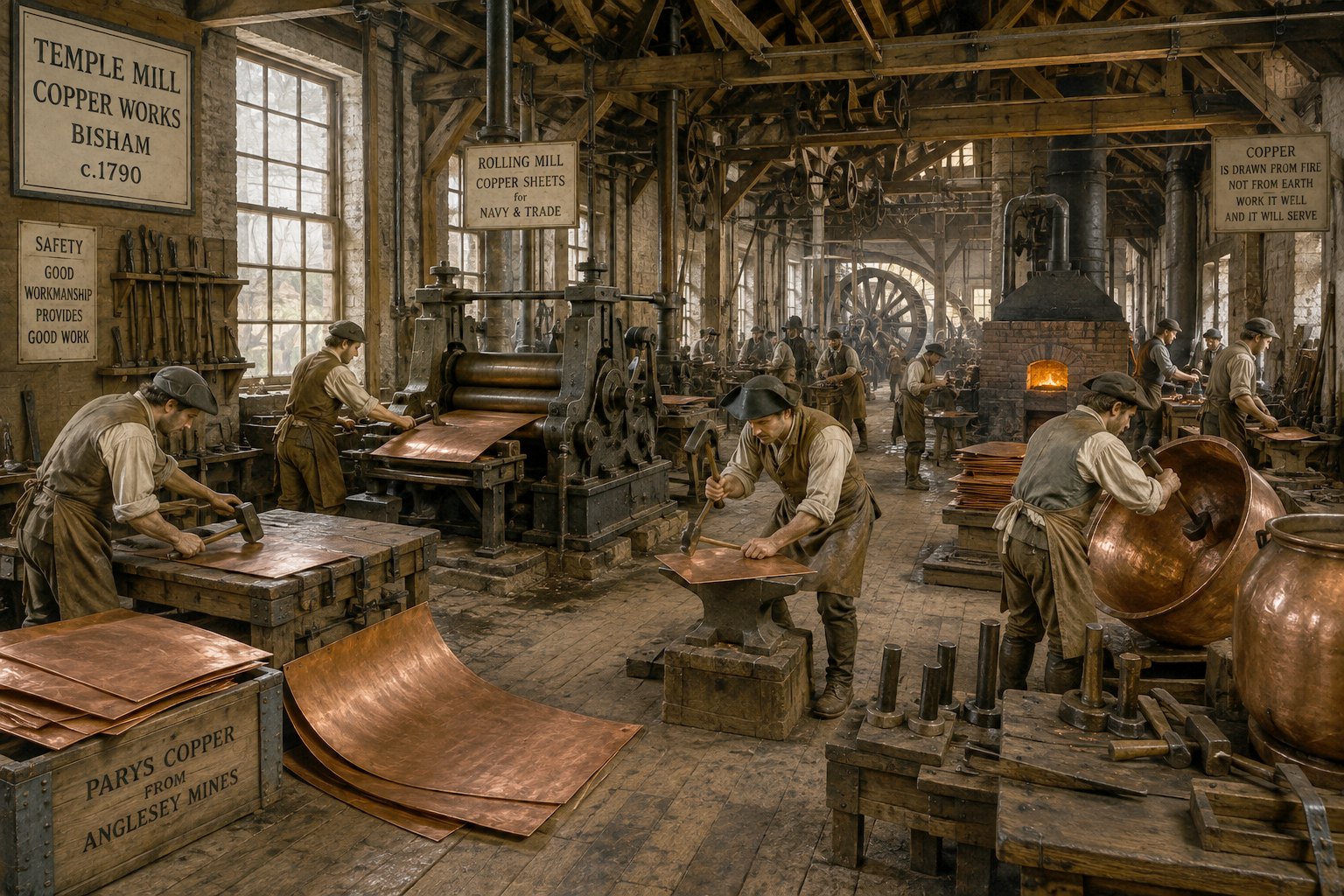
Among the more skilled metalworkers were men described as copper-bottom beaters. Their craft to beat the copper sheets with mallets and hammers to fit complex curves of a ship’s keel, bow, stern and garboard areas, as well as the rounded bottoms of kettles, vats and brewing vessels. It is rather pleasant to imagine that while Nelson was preparing his fleet for Trafalgar, local men from the Marlow area helped to manufacture the very copper that protected Britain’s warships.
By the end of the decade, Thomas Williams had become the dominant figure in the British copper industry, controlling a large proportion of the nation’s production and exerting a major influence on copper prices throughout Europe.
Williams was also an innovator. Because Anglesey possessed abundant copper but very little coal, he transported the ore to smelting works near the coalfields rather than attempting to bring vast quantities of coal to North Wales. Today we would describe this as an integrated supply chain, but in the eighteenth century it was a remarkably modern approach to industrial organisation.
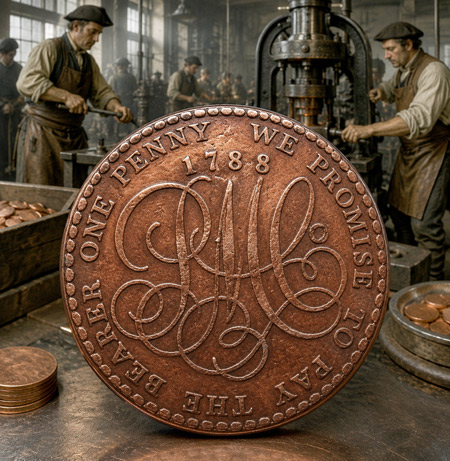
When Thomas Williams wanted to pay his miners, he faced a problem familiar to every employer – there simply weren’t enough coins issued by the government. His solution was characteristically bold. Rather than waiting for the Royal Mint to act, he made his own. Millions of Parys Pennies poured from his copper works and soon found their way into pockets and purses across Britain. It was a remarkable achievement: the same copper that protected Nelson’s ships beneath the waves also jingled in the pockets of ordinary working people from Anglesey to London—and quite possibly in Marlow too.
Success brought wealth on an extraordinary scale. By the end of the eighteenth-century Thomas Williams was probably the richest man in Wales and one of the most powerful industrialists in Britain. His influence reached far beyond the copper trade. He became Member of Parliament for Great Marlow in 1790 and, although he died in 1802, just three years before Nelson’s victory at Trafalgar, the industrial empire he created continued to supply the copper that helped keep Britain’s fleet at sea and played a quiet but vital part in securing Britain’s command of the oceans.
Their influence on the town lasted well into the nineteenth century. Williams also purchased the Marlow market and his family continued to play a prominent role in local affairs long after his death.
Of course, like many great industrialists of the age, Thomas Williams was a complex character. Admirers praised his extraordinary energy and business ability. His rival Matthew Boulton described him as “the despotic sovereign of the copper trade”, a compliment and criticism in equal measure. He drove hard bargains and expected the same determination from those who worked for him. Mining and metalworking were dangerous occupations, and although wages at Parys Mountain were generally considered competitive, conditions were harsh by modern standards.
His legacy also has a darker side. Some of the copper products manufactured by his companies were traded in West Africa as part of the transatlantic slave trade, and Williams opposed attempts to abolish that trade because of its commercial impact on his businesses. It is an uncomfortable reminder that many of the fortunes of the Industrial Revolution were built in a world whose moral standards differed greatly from our own.
Nevertheless, his contribution to Britain’s naval success cannot be overstated. Every time one of Nelson’s ships crossed the Atlantic without being crippled by shipworm, every time a British frigate outsailed a French opponent because its hull remained clean, and every time a blockade was maintained month after month, Thomas Williams’ copper was quietly playing its part.
Today, visitors walking beside the Thames at Temple Mill Island see an attractive residential setting with little hint of its industrial past. Yet more than two centuries ago, the sound of water wheels, hammers and furnaces echoed across the river. Copper from the mountains of Anglesey arrived here to be worked by local hands before continuing its journey to the Royal Dockyards at Portsmouth, Chatham and Plymouth.
The next time you visit HMS Victory at Portsmouth, it is worth remembering that although the famous ship was built in Chatham and fought at Trafalgar off the coast of Spain, part of the story beneath her waterline may well have passed through Bisham and Marlow, fashioned by workers whose descendants may still live in our area today.