By Gerry Palmer
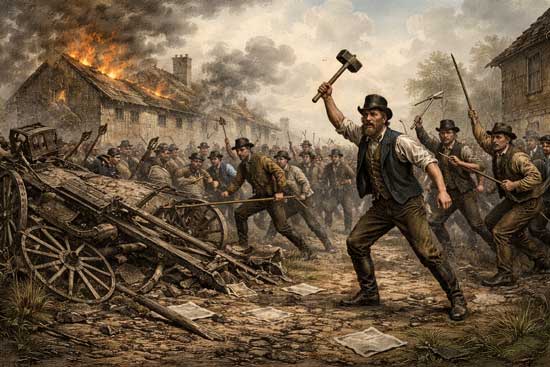
During the summer of 1830, the Swing Riots (named after the mysterious figure known as Captain Swing) spread like wildfire across southern Britain. They began with attacks on the much-hated threshing machines, which displaced agricultural labourers, and soon escalated into wage and tithe riots, along with the wholesale destruction of symbols of perceived oppression such as workhouses, mill machinery, and tithe barns. By the end of December 1830, 2,000 people involved in the riots were awaiting trial. Of these, 19 were executed and more than 500 transported.
Here is just one day from High Wycombe’s part in the story.
A few weeks before our day begins, four strangers were spotted in High Wycombe, and soon afterwards threatening letters were received by local farmers and mill owners. This followed a pattern that we now know was repeated in other Swing Riot centres across southern England. On 30th November, Wycombe was the scene of a riot in which between 100 and 600 people—depending on the witness—destroyed considerable mill property, while several groups roamed the area demanding money with menaces from any unfortunate people they encountered.
Our part of the story begins on Monday 5th December 1830, when a large group of paper-makers assembled at Flackwell Heath, armed with sledgehammers and crowbars. They marched on the paper mill at Loudwater and forced an entrance. A shot was fired in an attempt to intimidate the rioters, but it only increased their anger. The now-rampaging mob broke windows, and a quantity of vitriol was thrown over them, severely burning many.
The rioters pressed on and marched to Mr Allnutt’s mill at Marsh Green, which they destroyed. Next, they moved to Hayes Mill, where Mr Hayes addressed the mob and informed them that he had ordered his machine to be stopped, and that it would not restart without agreement. He explained that if they destroyed his mill, his 53 employees would lose their livelihoods, and he invited the leaders inside to see for themselves.
Sadly, it was to no avail, and the rioters began their demolition. One of Mr Hayes’s workmen even attempted to stop them by brandishing a red-hot poker, but eventually he was forced to flee. The Reverend Mr Vincent arrived and read the Riot Act.
The rioters then moved to Lansdale Farm, where they smashed his threshing machine before heading on to the Red Lion pub. Here, according to local accounts, they “plentifully regaled themselves with beer” before moving on to Plaistow’s paper mill in Loudwater. The owner, having seen what had happened elsewhere, announced that his machine would no longer be used—but the rioters broke in and destroyed it anyway.
Colonel Vyse, the High Sheriff, arrived on the scene and, with a number of local gentlemen, attempted to stop the riot. They were showered with stones, and the Colonel’s face was badly cut. The rioters then moved on to Hedge Mill and quickly destroyed the machinery there as well. By this point, many of the Swing Rioters were overcome by fatigue, and several were in a state of intoxication.
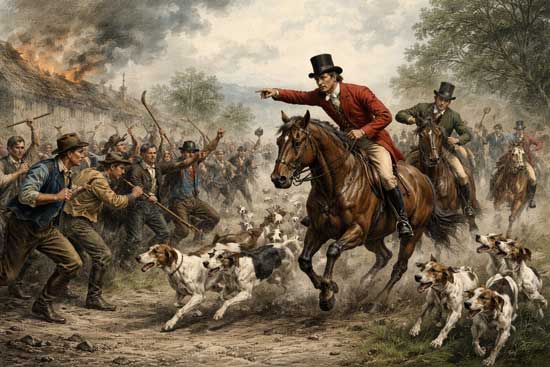
A local hunt, complete with a pack of stag-hounds, entered the fray and, after a brief consultation with the authorities, began to make an impression on the rioters. Several shots were fired. One rioter was wounded in the chest, and two others were carried away apparently lifeless. Nine further rioters, including the ringleader—who was not a local man—were arrested.
Six grenadiers from the Foot Guards arrived in post-chaises and escorted the prisoners to Wycombe, where they were placed in custody. Around £12,000 worth of damage had been done.
Sadly, the main outcomes—aside from several hundred mill workers losing their jobs—were that the wages of agricultural labourers continued to decline. In 1830, an agricultural labourer earned nine shillings a week; by 1834, this had fallen to just six shillings. The following year, 1834, the Tolpuddle Martyrs formed a trade union in protest against the conditions endured by rural workers, but they too were famously transported. Trade unions were not fully decriminalised in the UK until 1876.
I am not certain what became of the rioters arrested on our particular day, but among those arrested during the earlier disturbances, several were heavily fined (£30) and bound over to keep the peace for the rest of their natural lives; some were acquitted, while several others were transported for seven years. The ringleader was told by the judge that he was fortunate to escape with his life.
Entertainingly, one of the barristers involved was named “Mr Bligh” and, although we do not know whether he was actually related to the captain of the Bounty, it must be said—he spoke for the defence!