By Gerry Palmer
The tale of the Hughenden Dragon is a little-known piece of local folklore, even among the residents of High Wycombe. It hasn’t been featured in the more recent surveys of British dragon myths and was essentially rediscovered by historian Alan Cleaver.
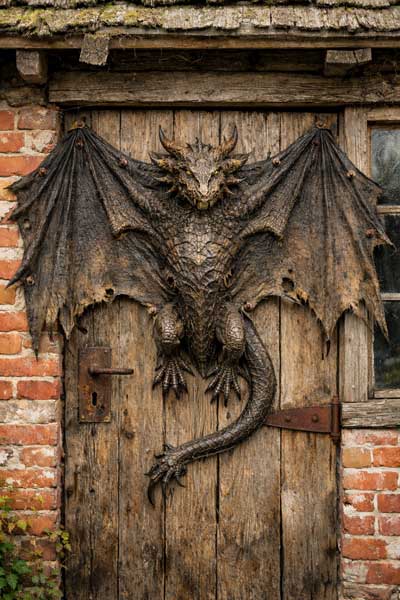
The earliest account of this story appears in The Gentleman’s Magazine from October 1758, where a man named Edgar Bochart wrote a letter detailing his encounter with the legend. He recounted hearing about a water serpent during a countryside visit that summer. Initially dismissing the story as fanciful, his curiosity was piqued enough to visit a farm where the incident was supposedly depicted on a wall. There, he found a painting of a dragon-like creature, alongside a handwritten account of its history. Bochart was convinced that the story was “true in every respect.”
The Encounter at the Pond
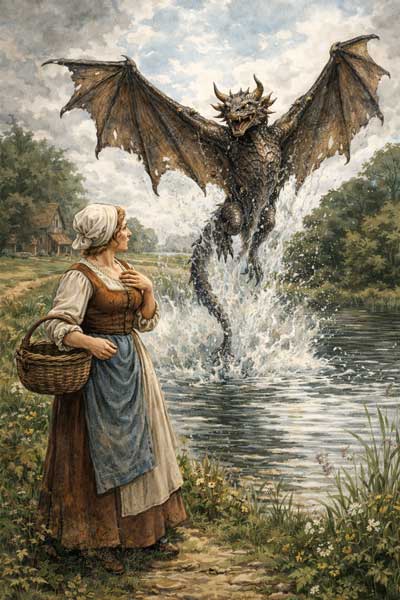
According to the tale, the events took place in 1578. A woman who frequently collected water from a local pond began to notice a large water serpent lurking there. Frightened, she shared her experience with her neighbors, and together they devised a plan to get rid of the creature. The woman would sit by the pond to lure the serpent, while her neighbors hid in the surrounding bushes, ready to attack. The plan worked, and they succeeded in killing the serpent. To commemorate the event, the serpent’s skin was stuffed with straw and displayed outside the farm.
Over time, the skin decayed, prompting the residents to paint a likeness of the creature on the farm’s wall. This painting also needed occasional restoration as it aged. By the time Bochart saw it, the artwork was about 40 years old and depicted a traditional dragon-like figure.
The Farm, the Church, and the Knights Templar
Bochart described the farm as having numerous armorial carvings, which led him to speculate that it might have once been a hospital for the Knights Templar. He noted that about half a mile down the valley lay a church known as Hitchendon, which is now recognized as St. Michael and All Angels in the parish of Hughenden. The church’s dedication to St. Michael, a saint often associated with dragons in folklore, added an intriguing layer to the legend.
In the 18th century, an ancient manor known as Rockhalls stood nearby, home to the Wellesbourne family. This family was known for their elaborate armorial carvings and a rather ambitious claim to be descended from the Montfort family, leading them to place Montfort-related symbols in the church at Hughenden. The old manor house was demolished in the late 1700s, but some of its carvings were preserved and incorporated into nearby buildings, including what is now Rockhalls Farm. This historical detail suggests that Rockhalls Farm was likely the location where Bochart saw the dragon painting.
The Possible Location of the Dragon’s Pond
Identifying the specific pond where the serpent was said to have lived is challenging. The most plausible site is near Rockhalls Farm, across the road and about 100 yards uphill toward Widmer End. This area features a pond that might have once been part of the old Rockhalls moat. The pond has silted up over the years and is surrounded by bushes and brambles, fitting Bochart’s description of “briers.”
Skepticism and Community Pride
The historian Lipscomb, writing in the 19th century, dismissed the Hughenden Dragon as an “absurd story” that hindered the advancement of rational thought. However, modern perspectives are more lenient, aligning with folklore expert Jacqueline Simpson’s view that dragon legends often serve to symbolize a community’s pride or distinctiveness. A local dragon legend, she argues, is a claim to fame, albeit one often shared with a hint of humor.
Additional Variations of the Story
A variation of the story was shared by Mrs. King, an 85-year-old woman from Princes Risborough. She recalled a different version her father told her in childhood, which involved a woman and a baby in a pram being swallowed by a dragon near a pond located between Four Ashes and Terriers. Although this version adds dramatic elements, the core idea of a dragon lurking near a pond remained consistent.
Mrs. King mentioned that the pond from her father’s story was the same one identified by local historian Clive Harper, suggesting that oral tradition had morphed the tale over time. Her account also referenced a spot behind a farm on a footpath between Four Ashes and Hazlemere, where a small moat and deep ditch dating from the 12th century can still be seen. This location is thought to be associated with the ruins of a castle once connected to Simon de Montfort, further blending the lines between history and myth.
A Legend to Remember
Though the original painting of the Hughenden Dragon has long since faded, the story endures as a piece of local folklore, illustrating how legends can evolve and persist through time. While it may be easy to dismiss such tales as fanciful or irrational, they often reflect deeper cultural values and offer a window into the past—a mix of history, pride, and imagination that continues to fascinate.