By Gerry Palmer
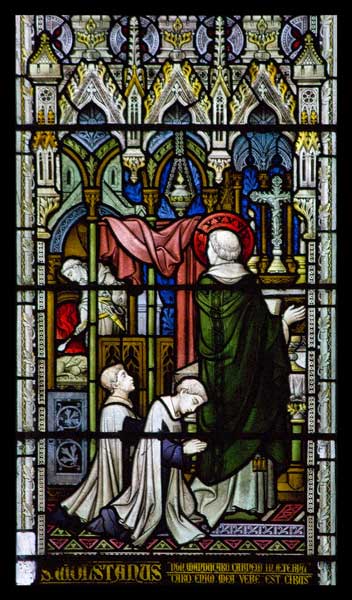
St Wulfstan was the Saxon Bishop of Worcester both before, and for nearly thirty years after, the Norman Conquest. He was a genuinely good and holy man—so good, in fact, that he very nearly became the Patron Saint of England when that role was considered alongside the creation of the Order of the Garter in 1350. (There is still a movement to have him replace St George!)
Although the saint is well known in historical circles, what is less well known is that two of his many reported miracles took place in High Wycombe, though one was more likely just outside the town in Bradenham.
Although a deeply pious and religious man, Wulfstan wielded great power and inspired fierce loyalty. He was made bishop on the recommendation of both King Edward the Confessor and the future King Harold Godwinson. Indeed, Harold may not have become king had it not been for Wulfstan, as it was the bishop who persuaded the Northerners to accept him. Wulfstan later became a trusted adviser to both Edward and Harold, regularly attending the courts of both Saxon and Norman kings, especially at Easter, Christmas, and Whitsuntide.
Indeed, it was on one of these journeys that he performed his first, and lesser, Wycombe miracle. His retinue had stayed overnight in a decrepit Wycombe inn, reputedly on the London Road. The next morning, the building began to creak and sag alarmingly. Everyone but the bishop ran outside, realising he was still indoors. They shouted for him, but no one was willing to re-enter. Wulfstan stood firm, rebuked their panic, and refused to leave the building until the animals had been released. As he walked out of the inn, it shook violently and collapsed. The house had delayed its fall while the saint was still within it.
A tale is also told of the bishop’s piety, despite his particular liking for roast goose. One day, possibly after one of his many night-long vigils and fasts, he had not yet eaten breakfast when he was called upon to say Mass. As he entered the church, he passed near the kitchen and the smell of goose caused his thoughts to wander to his dinner. However, his conscience reproached him, and he vowed before the altar that from that day onwards he would never again eat meat. He remained a vegetarian for the rest of his life—except on festivals, when he ate fish.
The second, and more impressive, Wycombe miracle took place after he had consecrated a local church. All Saints in Wycombe is often credited, but St Botolph’s in Bradenham is more likely, as it contains stonework from that period and the patron of the new church, Swertlin (some texts say Swertin or Swertling), lived there. Indeed, his brother, Herding, held a substantial estate in the village. During the dinner after the ceremony, Wulfstan was told of a maidservant who had a tumour in her head which caused her tongue to protrude, making eating difficult and chewing impossible. He possessed a gold bezant said to have been pierced by the spear of Christ (there were several reputed holy spears at the time, this being before the famous “discovery” of the spear said to have saved the First Crusade). Wulfstan dipped this bezant in water to hallow it, and sent the holy water to the maid, who was cured.
The bishop once lodged overnight at Marlow and, as was his invariable practice, told his servants that he was going to the church. Unfortunately, this was some distance away along a road deep in mud, while a storm of snow and sleet was raging. One of his clerks—a man called Frewin—was keen to make Wulfstan change his mind and deliberately led him where the mud was deepest. Wulfstan sank into the mud up to his knees and lost a shoe, but he gave no indication that he realised the trick.
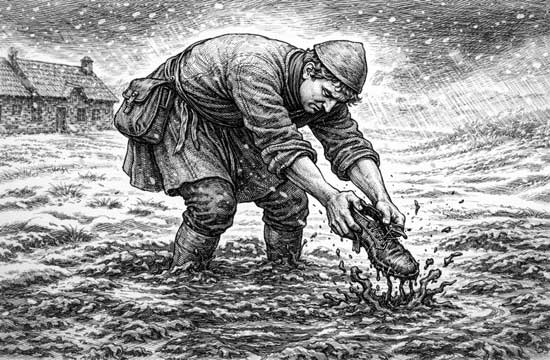
Eventually, he returned to the inn half-dead with cold and gently rebuked the impudent clerk before dismissing the offence with a smile—then sending him back to find the lost shoe!