By Gerry Palmer
Nestled on the western edge of High Wycombe, RAF Booker — now known as Wycombe Air Park — may appear today to be a modest civilian aerodrome, but during the Second World War it played an important role in Britain’s wartime aviation training programme. Although Booker itself was not a front-line combat station, it formed part of a remarkable concentration of military and intelligence activity across Buckinghamshire, where airfields, secret map-making units and covert communications centres all contributed to the Allied war effort.
The Foundation of Booker Airfield
Before the outbreak of war, the land at Booker was open countryside on the high ground above High Wycombe and Marlow. During the late 1930s, as tensions in Europe increased and Britain began expanding its air defences, the site was selected for development as a flying field. Originally intended as a civilian and reserve flying training aerodrome, it was quickly requisitioned by the Air Ministry once war became inevitable.
Construction of the airfield began in 1938–39, and by 1941 the site had become fully operational as RAF Booker. Unlike larger bomber or fighter stations, Booker was built primarily as a grass airfield, with several landing strips radiating across the open plateau. It featured the typical wartime infrastructure of the day: hangars, workshops, barracks, technical buildings and dispersal areas, though on a smaller scale than major operational RAF bases.
Its elevated position gave pilots excellent visibility over the Chiltern Hills and Thames Valley, making it a suitable location for flying instruction.
Booker’s Wartime Role: Training the RAF’s New Pilots
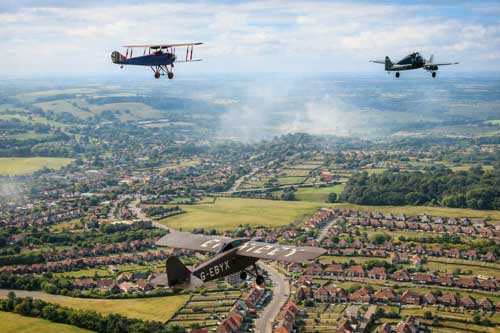
RAF Booker’s principal wartime purpose was pilot training. During the war it became home to No. 21 Elementary Flying Training School (EFTS), one of many schools established to train the vast number of new aircrew needed by the Royal Air Force.
At Booker, trainee pilots took their very first steps into military aviation. Young men, many barely out of school, arrived to learn the fundamentals of flight before moving on to more advanced operational training elsewhere. Instruction covered take-offs and landings, navigation, aerobatics and emergency procedures.
Training was carried out mainly using aircraft such as the de Havilland Tiger Moth and Miles Magister, both classic British trainer aircraft of the period. At its busiest, Booker handled dozens of aircraft at once, and wartime residents of nearby villages often recalled the near-constant hum of engines overhead as trainee pilots circled above the Chilterns.
Courses at Booker were intensive, often lasting only a few weeks. The pressure was immense: Britain needed pilots quickly, and not all trainees passed. For many young airmen, Booker was the place where their RAF careers truly began.
The Glider Pilot Connection
From 1942 onwards Booker also contributed to the training of personnel destined for the Glider Pilot Regiment. These highly skilled soldiers would later fly gliders carrying troops into battle during some of the war’s most famous airborne operations, including the Normandy landings and Operation Market Garden.
Though full glider instruction often took place elsewhere, Booker served as an early-stage training location for pilots preparing for this hazardous and elite branch of service. This linked the otherwise quiet Buckinghamshire airfield to some of the war’s boldest operations.
RAF High Wycombe and Fighter Command
Just a short distance from Booker stood another site of enormous wartime importance: RAF High Wycombe. While Booker trained pilots in the basics of flight, RAF High Wycombe became one of the most significant command centres in Britain’s air defence network.
Originally established before the war, RAF High Wycombe expanded rapidly during the conflict and became the headquarters of RAF Bomber Command’s No. 3 Group before later serving as headquarters for Fighter Command during parts of the war. Hidden within a network of underground bunkers and reinforced command rooms, the station played a critical role in directing air operations and coordinating Britain’s aerial war effort.
Its operations rooms processed intelligence, monitored aircraft movements and coordinated fighter and bomber activities across southern England and beyond. Senior officers and planners worked there around the clock, making decisions that influenced major bombing raids and defensive operations.
RAF High Wycombe’s strategic importance made the town and surrounding district a far more significant military target than many local residents may have realised. Though the area escaped the worst of the Blitz, its command and communications functions meant it was deeply involved in the conduct of the wider war.
Hughenden Manor: Mapping the War from the Air
Just a few miles north-east of Booker stood Hughenden Manor, the Victorian country house best known as the former home of Benjamin Disraeli. During the war, however, Hughenden took on a highly secretive new purpose.
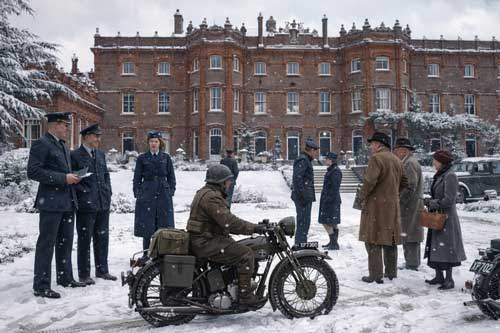
The manor became home to a secret photographic interpretation unit connected to Allied intelligence and the RAF. Working in great secrecy, teams of specialists studied aerial reconnaissance photographs taken over occupied Europe. Their job was to analyse enemy positions, identify military installations, track troop movements and help plan bombing raids and invasion operations.
The work carried out at Hughenden was vital in preparing for D-Day, with analysts poring over thousands of reconnaissance images to build up an accurate picture of German defences. Many local residents had no idea what was happening behind the manor’s closed doors, and strict secrecy was maintained throughout the conflict.
Thus, while trainee pilots learned to fly at Booker, the intelligence gathered from the skies was being analysed only minutes away at Hughenden.
Hurley: Secret Wireless and Espionage Work
Further south, near the Berkshire border, the village of Hurley also played a little-known wartime role.
Hurley was associated with secret communications and clandestine wireless operations linked to Britain’s wartime espionage networks. The area was used by organisations involved in covert radio communications, including work supporting agents operating behind enemy lines. Wireless operators and intelligence personnel in the area helped manage secret transmissions between Britain and occupied Europe.
Although much of the detail remains less publicly documented than at Bletchley Park or Hughenden, Hurley formed part of the wider network of hidden wartime facilities supporting espionage, resistance movements and intelligence gathering.
This meant that within only a few miles of Booker there existed not only an RAF training airfield, but also secret centres for photographic intelligence and covert communications.
Aircraft in the Skies Above Buckinghamshire
With Booker, High Wycombe, Hughenden and numerous military sites operating simultaneously, the skies above Buckinghamshire became exceptionally busy throughout the war. Training aircraft from Booker flew daily circuits over the Chilterns, while military transport aircraft, bombers and liaison aircraft regularly passed overhead en route to larger operational stations across southern and eastern England.
American bombers from nearby United States Army Air Force bases in East Anglia were frequently seen crossing the region, and local people often remembered watching large formations of Flying Fortresses and Liberators passing high overhead on their way to occupied Europe.
The constant aerial activity meant wartime Buckinghamshire experienced the sights and sounds of war almost every day, even though it lay some distance from the coast and front lines.
Aircraft Crashes and Wartime Losses in the Area
Unfortunately, such heavy flying activity inevitably brought accidents. The hills and valleys of the Chilterns, combined with wartime pressures, poor weather and the inexperience of trainee pilots, made the area around Booker and High Wycombe the site of numerous aircraft crashes during the war.
RAF Booker itself saw several training accidents, as young pilots learning to fly sometimes lost control during take-off, landing or aerobatic manoeuvres. Although every effort was made to maintain safety, wartime pilot training was rushed and dangerous, and accidents were considered an unfortunate reality.
Beyond the training school, a number of larger military aircraft also crashed in the surrounding countryside. Local woods and fields around Penn, Lane End, West Wycombe and Walters Ash were the sites of several wartime incidents involving RAF and American aircraft.
One of the most remembered losses in the wider area involved heavy bomber aircraft passing over Buckinghamshire, and memorials in nearby countryside commemorate crews who lost their lives when aircraft came down in fields or woodland. Even today, small plaques and memorial stones can be found marking these tragic sites, quiet reminders of the dangers faced not only in combat but in training and transit.
Many wartime residents recalled hearing the sudden roar of struggling engines, followed by the sound of impact in the hills, and then seeing military vehicles race towards the crash scene. For local communities, such incidents brought the reality of war sharply home.
Daily Life and Local Impact
The war transformed the character of the area around Booker. High Wycombe and its neighbouring villages saw an influx of RAF personnel, military vehicles and wartime workers. Roads filled with lorries, bicycles and uniformed servicemen, while aircraft noise became part of everyday life.
For local residents, Booker was a constant reminder of the war overhead. Training accidents, though thankfully not common, did occur, and crashes involving trainee pilots were an unfortunate reality of wartime flying schools. Meanwhile, the blackout, rationing and fear of enemy bombing shaped daily civilian life.
Yet many locals remembered the RAF personnel fondly, and wartime friendships between servicemen and local families were common.
After the War
Following the end of the Second World War, RAF Booker remained in military use for some years, though its role gradually diminished as the RAF reduced its wartime infrastructure. By the early 1960s military operations had ceased, and the site transitioned into civilian use.
Booker and the Cold War’s 4-minute warning
Although best remembered for its wartime role, Booker’s military importance did not end with the Second World War. During the Cold War the station continued to play a part in Britain’s national defence network when it became home to the United Kingdom Regional Air Operations Command (UK RAOC). From here, the Director of the United Kingdom Warning and Monitoring Organisation (UKWMO) was based, overseeing one of the most sobering responsibilities of the nuclear age: the authority to instigate the national four-minute air raid warning in the event of an impending nuclear attack. This warning system, familiar to generations through public information films and civil defence campaigns, was intended to alert the population that hostile aircraft or missiles had been detected and that only minutes remained before impact. Though never used in earnest, the presence of such a command facility at Booker serves as a reminder that the airfield remained an important strategic site long after the wartime aircraft had fallen silent.
Today the airfield survives as Wycombe Air Park, continuing its aviation heritage as a centre for private flying, pilot training and aviation businesses. Although much changed from its wartime appearance, the site still retains the outline and atmosphere of the old airfield.
A Quiet Corner of a Hidden War
RAF Booker may never have launched bomber raids or fighter interceptions, but its contribution to Britain’s war effort was nonetheless significant. It trained the pilots who would go on to serve across the world, supported airborne forces and stood at the heart of one of Britain’s most fascinating wartime landscapes.
Together with RAF High Wycombe’s command bunkers, the secret photo interpreters at Hughenden Manor and the covert communications work around Hurley, Booker formed part of an extraordinary local network of military and intelligence sites hidden among the Buckinghamshire hills.
Today, many pass through the area unaware of just how much wartime history lies beneath the peaceful countryside — but during the dark years of the 1940s, this corner of Buckinghamshire was quietly helping to win the war.